Designing High-Performance Fiber Optic Networks: Advanced Strategies for Scalable Infrastructure in 2026 and Beyond
When you’re responsible for delivering a project that must perform not just today—but for the next 10, 15, even 20 years—there’s one decision that quietly determines your success:
How well your fiber optic network is designed from the very beginning.
I’ve seen it time and time again. Two projects may look identical on paper—same square footage, same budget range, same timeline. Yet one performs flawlessly for years, while the other struggles with bottlenecks, costly upgrades, and frustrated users.
The difference? Strategic fiber design.
At All Day Cable, Inc., we don’t just install fiber—we design infrastructure that scales, adapts, and performs under pressure. Let’s walk through what truly separates a basic fiber install from a high-performance, future-ready network.
Why Fiber Design Matters More Than Ever in 2026
The demands on today’s networks are no longer linear—they’re exponential.
You’re not just supporting:
Internet access
Voice systems
Basic data transfer
You’re supporting:
Cloud-based operations
Real-time analytics
AI-driven applications
Smart building systems
5G infrastructure
IoT ecosystems with thousands of endpoints
And here’s the truth most people overlook:
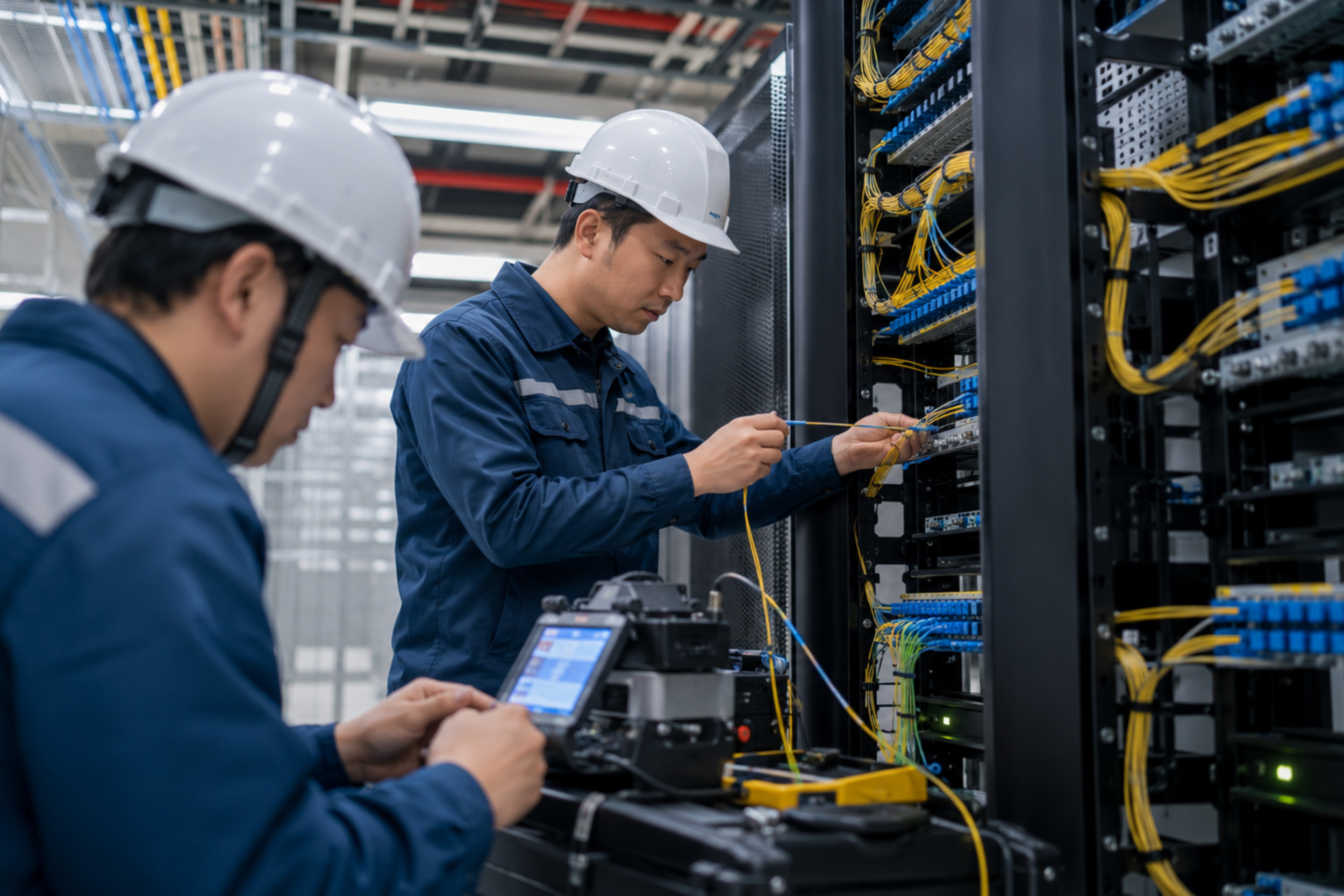
You can upgrade electronics. You can’t easily redo your cabling backbone.
That’s why fiber design must be done right—the first time.
The Foundation: Designing for Scalability, Not Just Capacity
One of the biggest mistakes in telecom infrastructure is designing for current demand rather than future growth.
A high-performance fiber network is built with:
Excess Strand Capacity
Instead of installing just enough strands, we design with:
Dark fiber for future expansion
Redundant paths
Dedicated strands for critical systems
Because when expansion happens—and it will—you’re ready.
Modular Architecture
Your network should grow in phases, not require full redesigns.
We implement:
Scalable MDF/IDF structures
Modular patching systems
Flexible cross-connect strategies
This allows your infrastructure to evolve without disruption.
Backbone Strategy: The Real Power Move
The backbone is where performance is either won or lost.
Single-Mode vs. Multi-Mode (And When to Use Each)
We guide clients based on real-world application, not theory:
Single-Mode Fiber (SMF):Ideal for long-distance, campus-wide, and future-proof deployments
Multi-Mode Fiber (MMF):Cost-effective for shorter runs within buildings
Most high-performance designs today use a hybrid approach—and that’s where expertise matters.
Ring Topology vs. Star Topology
This is where advanced design thinking comes in.
Star Topology:Simpler, cost-effective
Ring Topology (Preferred for Critical Systems):Enables automatic rerouting
For EOCs, government facilities, and enterprise campuses, ring architecture is a game-changer.
Redundancy: Because Downtime Is Not an Option
Let’s be real for a moment.
If your network goes down:
Operations stop
Revenue is impacted
Safety systems may fail
Your reputation takes a hit
That’s why redundancy is not a luxury—it’s a requirement.
We design redundancy through:
Diverse pathway routing
Physically separated conduits
Redundant entry points into buildings
Failover-ready configurations
This ensures your network doesn’t just perform—it survives disruption.

Fiber + 5G + Edge: Designing for What’s Next
Here’s where most installations fall behind.
They design fiber as a standalone system.
We design fiber as the foundation for future technologies, including:
5G Infrastructure
Small cells require dense fiber backhaul
Edge Computing
Localized data processing demands:
Low latency
High-speed connectivity
Distributed fiber nodes
Smart Buildings
Everything from lighting to HVAC depends on:
Reliable fiber backbone
High-capacity structured cabling
Seamless system integration
The Contractor & PM Advantage: Why This Matters to You
If you’re a general contractor or project manager, this is where you win—or lose—projects.
When fiber is designed correctly:
You avoid change orders
You stay on schedule
You meet performance specs
You impress your client
When it’s not:
Delays happen
Costs increase
Finger-pointing begins
The right telecom partner doesn’t just install—they protect your timeline and your reputation.
What Makes a Fiber Design “High-Performance”?
At All Day Cable, Inc., every high-performance network includes:
✔ Strategic strand allocation
✔ Redundant topology design
✔ Future-ready pathway planning
✔ Clean, labeled, documented infrastructure
✔ Compliance with all industry standards (BICSI, TIA/EIA, NEC)
✔ Integration readiness for smart systems and emerging tech
And most importantly…
✔ A design that aligns with your long-term operational goals
Final Thought: Build It Once. Build It Right.
I want you to think about this for a moment.
When your building is complete…
Will your infrastructure support growth—or hold you back?
Because fiber isn’t just cabling.
It’s the foundation of everything your organization will become.
Ready to Design a Network That Performs for the Next Decade?
If you're planning a project—or even rethinking your current infrastructure—this is the time to get it right.
📅 Schedule a consultation with All Day Cable, Inc.
Or download our Capability Statement to see how we deliver 100% on-time, on-budget performance